




Our Group and Mission

Formally The D3 Group (D3G) comprises a translational research and education network spanning the Developmental Dental Defect (DDD = D3) and Chalky Teeth sector – originally across Australia and New Zealand (the Hub) and now around the world. But actually we are an eclectic bunch of individuals whose lives have been touched by D3 problems one way or another. Some of our families have experienced D3s first hand, many of us care for people with D3s either as dental practitioners or public health professionals, and many others are engaged in D3 research and education. We are also pleased to have a growing number of medicos and D3-savvy folk from industry amongst us (see D3G Down Under and International Friends).
All of us share the vision that teaming up and pulling together in a global "D3 family" effort will help get "chalky teeth" problems – particularly Molar Hypomineralisation and allied tooth decay – recognised better, understood better, and cared for better. Our overall mission is to make many of these problems go away through prevention – at medical (primary), dental (secondary) and social levels.
To achieve these social benefits, our primary aim is to help educate people about D3s as they pertain to them – families and patients, the public health sector and politicians, practitioners and industry,
researchers, educators and students. Hopefully, such an improved
foundation of science-based knowledge and understanding will
lead to widespread benefits across societies and around the globe.

Besides our focus on education and advocacy, we also aim to foster improved research and healthcare of D3s, with a focus on prevention. To do so, one key goal is to develop a scientifically-driven translational research network that strengthens our field and connects it with others around the world. By leveraging this cross-sector network – nicknamed the "D3 family" – our action plan is to develop a pathway towards "stronger science, better practice, and social good". A second major goal is to discover what causes Molar Hypomin and then learn how to cure it medically, leading to massive lifelong health benefits around the globe. Here our action points are distilled to "healthier babies, stronger teeth, and happier societies" (read more).
More practically, our key objectives are to:
- Disseminate information across the sector – including D3G members, students and the public
- Hold scientifically-flavoured events of interest to our diverse membership
- Undertake strategic planning and development – strengthening global efforts around D3s
- Foster research and training – build teams, support researchers and trainees
- Improve the health and well-being of people afflicted with D3s or chalky teeth
The D3-Chalky Teeth Movement

Following internationalisation of D3G in 2017 (below), we increasingly heard others talk about "the D3 movement" and "the chalky teeth movement". This of course was very pleasing to us – optimistically taking it as a compliment reflecting awareness of what we're up to and where we're headed. We first used these expressions in 2013 when launching the D3G website and Chalky Teeth Campaign (see report from here), little realising that those early dreams – to bring science, medicine and dentistry together to do something special for kids and society – would turn into today's reality.
Later, in preparation for our 2021 D3 Research Incubator, we drafted a one-liner definition for these professional and public-facing "science to
social good" initiatives – now merged into the "D3-Chalky Teeth
movement" – as follows.
The D3-Chalky Teeth movement is an international, science-driven,
child health initiative aimed at improving societies worldwide
To justify this statement, we proudly point to wins from the Chalky Teeth Campaign (WFCT network, HB=ST, Sam's Story Club), international engagement, world-first events, reconceptualised global health problem and social impact. In 2024, celebrating the adoption of our flagship translational paradigm by a leading academic journal, we bestowed the D3-Chalky Teeth movement with its own logo as above.
Our thanks go to the many wonderful people from around the globe who've teamed up to make this unique translational movement happen.
History of The D3 Group
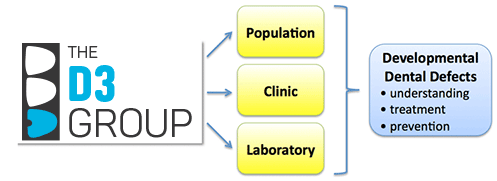
Increasing dental awareness of D3s, plus uncertainties regarding their cause and treatment, led to the initiation in 2007 of an informal group of interested practitioners, scientists and public health representatives from Melbourne. Spear-headed by scientist Mike Hubbard and paediatric dentist David Manton, this informal group grew rapidly to include interested parties from elsewhere in Australia and New Zealand. As the figure depicts, a translational vision emerged, covering understanding, treatment and prevention at three operational levels (population, clinic and lab). At a network meeting in 2009, the decision was made to formalise the group as an Australasian, cross-sector network – and so The D3 Group (D3G) was born. Subsequent planning sessions by the Melbourne-based focus group led to agreement that better education was the number-one priority, and that a comprehensive, multi-targeted "online education resource" would be a major advance in this regard. In 2010, Rebecca Williams (then in her first year of training to be a specialist paediatric dentist) kindly agreed to include co-development of such a website in her doctoral research work. After beta-testing by the target user groups, the final draft website went online on 29th March 2013 and days later was launched to the dental community at meetings of the Australasian Academy of Paediatric Dentistry and the Australian Dental Congress. After responding to suggestions from across the D3G community, the official website launch event was held on 24th August 2013 together with release of a public-friendly media campaign about "Chalky Teeth" (see reports under News and Events).
Our D3 initiative can be traced back to 2003 when Mike Hubbard came to Melbourne with a brief to develop medico-dento-scientific research efforts in the tooth and bone arena under auspice of the Melbourne Research Unit for Facial Disorders, a translational initiative focussed on children. To get the ball rolling, Mike decided to pursue D3s as a worthy clinical problem, and to promote proteomics as a complementary research technology. By 2006, he had a State-wide technology network underway (launched in 2008 as Proteomics and Metabolomics Victoria) and so his attention turned to initiating a parallel translational network for D3. Tiring of the tongue-twisting terms then in common use (i.e. Developmental Dental Defects or DDD, Developmental Defects of Enamel or DDE), Mike coined the term "D3" as a much simpler alternative – and although it will always require explanation, this abstract moniker seems to have struck a chord with the greater dental fraternity and the public alike. In 2013, just a couple of days before public launch of the D3G website, Mike was told by a media consultant that "Molar Hypomin" was too complicated for public consumption (despite being more suitable than "Molar-Incisor Hypomineralisation", the academically favoured term of the day). Recalling a term used by his grandmother, Mike asked "how about chalky teeth?" and the rest is history – the Chalky Teeth media campaign took off, attracting national TV and radio coverage in Australia and over 40 reports around the world (media release, other links). Following further encouragement including broad professional acceptance of D3G's take on "chalky teeth", a dedicated Chalky Teeth Campaign landing site was launched in 2015. Early in 2017, the "We Fight Chalky Teeth" practice network launched in Tasmania – thanks to Garry Nervo for the idea of mirroring the global "fight against tooth decay" idiom. Read more about D3G's origins in the "MRUFD Story" booklet.
For further information on how we're tracking, see Our Social Impact.
Key events timeline
- July 2007, inaugural meeting with scientific presentations & networking (hosted by Dentsply)
- November 2007, 2nd scientific/network meeting (hosted by Dentsply)
- October 2008, 3rd scientific/network meeting (hosted by Dentsply)
- May 2009, 4th scientific/network meeting (supported by Dentsply & Colgate)
- September 2011, 5th scientific/network mtg and website pre-launch (Dentsply & Colgate)
- April 2013, D3G website launch to dental community (AAPD & ADC meetings, Melbourne)
- August 2013, official public launch of D3G website and medico-dental initiative (Melbourne)
- August 2013, initiation of D3G's "Chalky Teeth" media campaign (Australia)
- August 2013, Grace Suckling becomes the Patron of D3G (sadly, Grace passed in July 2015)
- November 2015, Chalky Teeth Campaign website launched (ANZSPD meeting, Adelaide)
- February 2017, "We Fight Chalky Teeth" Supporter Practice and Satellite Page launched
- May 2017, International Friends of D3G launched, D3G-ANZ becomes D3G Down Under
- May 2017, paid membership scheme launched (annual subscription added in October)
- May 2019, D3G's inaugural International Symposium on MH & Chalky Teeth announced
- October 2020, D3G's pre-symposium International Workshop held online (due to pandemic)
- November 2020, D3G's "100 years of Chalky Teeth" Campaign launched (here, here & here)
- October 2021, D3G's ground-breaking D3 Research Incubator held online (cf pandemic)
- December 2021, 100-year breakthrough on chalky enamel pathology by D3G researchers
- February 2022, D3G website reached 10-million-hits milestone (< 9 years since launch)
- October 2022, world-first translational symposium on Molar Hypomin & Chalky Teeth (here, here)
- January 2023, US National Library of Medicine & D3G redefined Molar Hypomin (here)
- September 2024, leading dental journal adopts D3G's MH-chalky teeth paradigm (here)
- October 2025, "D3 Africa Project" launched at world paediatric dental congress (here)
Acknowledgements
The D3 Group acknowledges:
- Start-up funding and ongoing support from the Melbourne Research Unit for Facial Disorders – special thanks to principal benefactors, Allan & Maria Myers, and Clinical Director, Andrew Heggie
- Fellowship support for Mike Hubbard from the Melbourne Research Unit for Facial Disorders (2003-13)
- Support for D3G scientific/network meetings from Dentsply (2005-12) and Colgate (2009-12)
- Support for Rebecca Williams' website project from Melbourne Dental School and MRUFD
- Hosting & support of Team Hubbard by UniMelb Departments of Paediatrics & Pharmacology
- Funding for the Chalky Teeth Campaign site from a University of Melbourne Engagement Grant
The D3 Group Website
This portal website is intended to help four target groups:
- Families – D3 sufferers (particularly kids) and their families
- Community – public health sector and politicians
- Practitioner – healthcare providers and their support industry
- Researcher – researcher workers and students
Our design intent has been to tailor each section to its target audience but also to pique curiosity so that cross-exploration of other sections occurs. We have also worked to make the website suitable for chairside use (on tablets such as iPad) as well as on laptop and desktop computers.
Although we feel obliged to maintain a reasonable level of curation over this website in its early developmental stages at least (rather than an open wiki style), our overriding goal is to ensure it meets users' needs and reflects consensus understanding of opinion leaders, whilst respecting D3G's scientific heritage and interests in prevention. Accordingly, we strongly encourage input of ideas, suggestions, tips, reinforcements and constructive critique – please email the website administrator (sharon.thed3group@gmail.com) or D3G director (Mike Hubbard) and we'll do our best to please.
D3G website credits
- Original website idea, architecture/design concepts, original text & figures, supervision – Mike Hubbard
- Concept co-development, original content and website management – Rebecca Williams
- Graphical design and concept co-development – Sharon Dunn
- HTML & mobile application implementation – Suzanne Thomson
- Project development and co-supervision of Rebecca Williams – David Manton
- Local photography – Hannah Hubbard
Special thanks go to the following D3G members for their generous contributions and support of this website development: Margarita Silva, Karen Kan, Louise Brearley Messer, Roger Hall, Paul Schneider, Felicity Crombie, Jon Mangum, Mike Swain, Joseph Palamara, Vidal Perez, Luke and Vicki Ditcham.
And we are particularly grateful to the following colleagues for providing clinical images for use on this website (only): Rebecca Williams, Aghareed Ghanim, Wanyi Lim, Debra Elsby, Marilyn Owen, Jamie Lucas, Clarence Tam and Daniel Cocker.
The D3 Group & CHALKY TEETH CAMPAIGN LOGOS
The D3 Group logo, comprising three incisor-like Ds stacked sideways (DDD), signifies that dental defects such as hypomineralisation (chipped blue tooth) typically occur in otherwise healthy mouths and bodies. A colourful connotation is that, as a result of accompanying pain and inconvenience, D3 problems sometimes leave sufferers "feeling blue".
Harmoniously, our Chalky Teeth Campaign logo depicts a "chalky molar" (see Molar Hypomineralisation) with a patch of chalky enamel at the top that has started to crumble (see our Chalky Teeth Lingo).
Logo credits:
- Graphic design & co-conceptualisation – Sharon Dunn
- Original concepts & design – Mike Hubbard
- D3G logo introduced in 2010, renovated in 2017
- CTC logo introduced in 2017
- D3-CT Movement logo introduced in 2024

Disclaimer
The D3 Group (D3G) seeks to ensure that all content and information published at this website is current and accurate. Accordingly, all content, information and architecture of D3G's website might be updated or changed without notice. However, D3G gives no assurance or warranty regarding the accuracy, timeliness or applicability of any of the contents, and D3G disclaims all liability in respect of such information.
Reference within this website to any specific commercial or non-commercial product, process or service by trade name, trademark, manufacturer or otherwise does not constitute or imply an endorsement, recommendation or favouring by D3G.
In addition, D3G cannot be held responsible for the contents of externally linked pages. Links to external websites are provided solely for visitors’ convenience. Links taken to other websites are done so at your own risk and D3G accepts no liability for any linked websites or their content.